
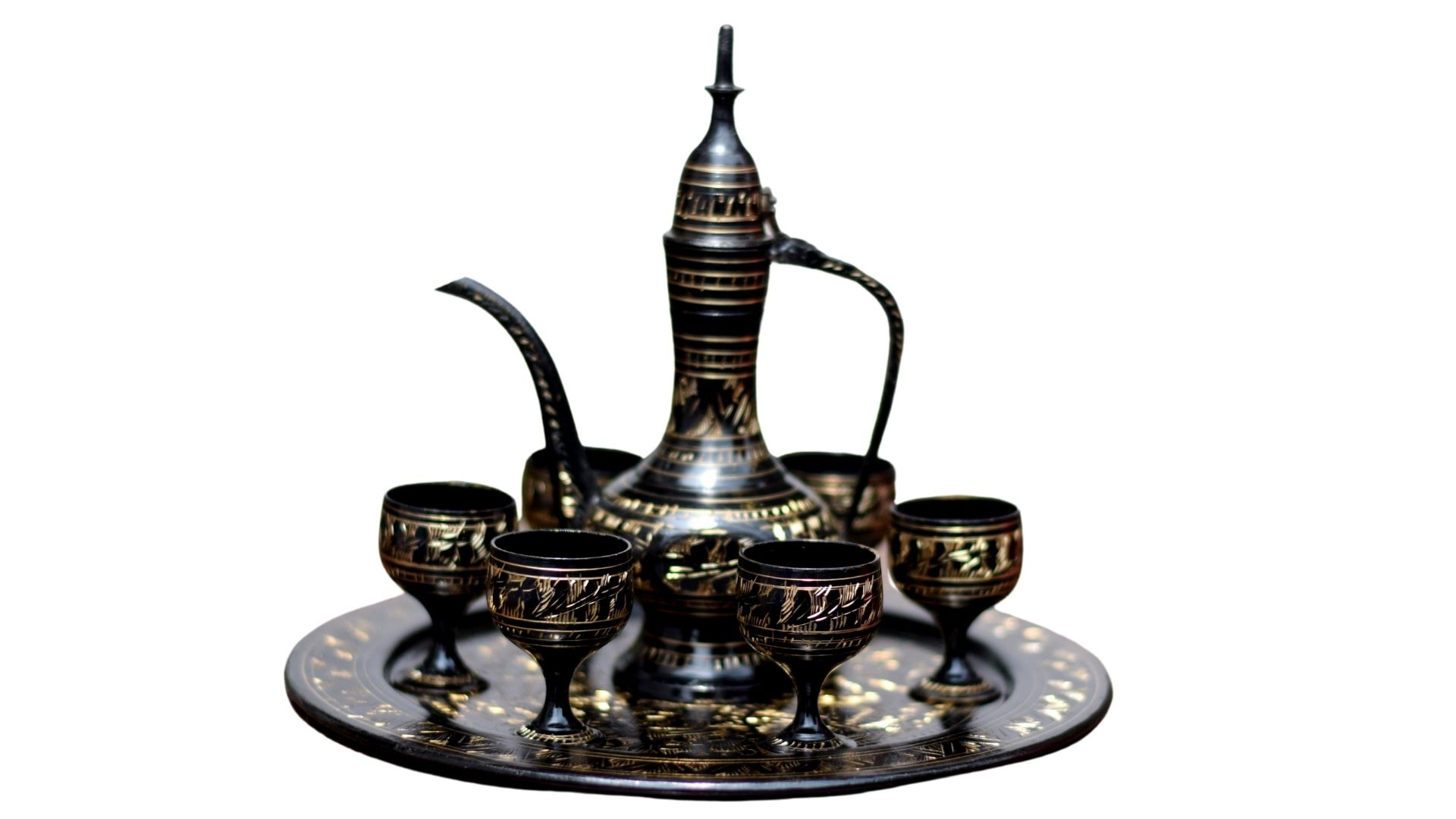
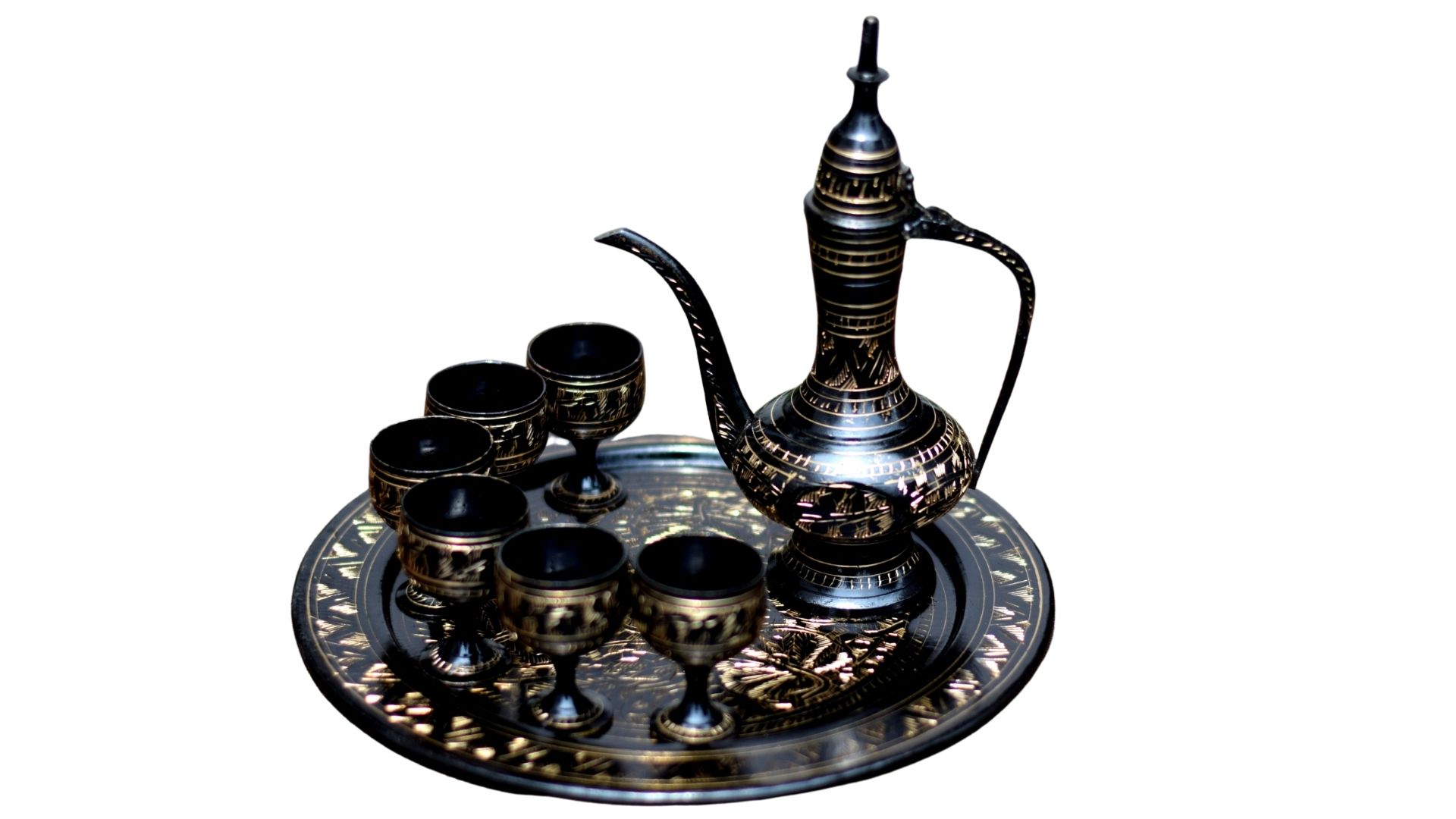
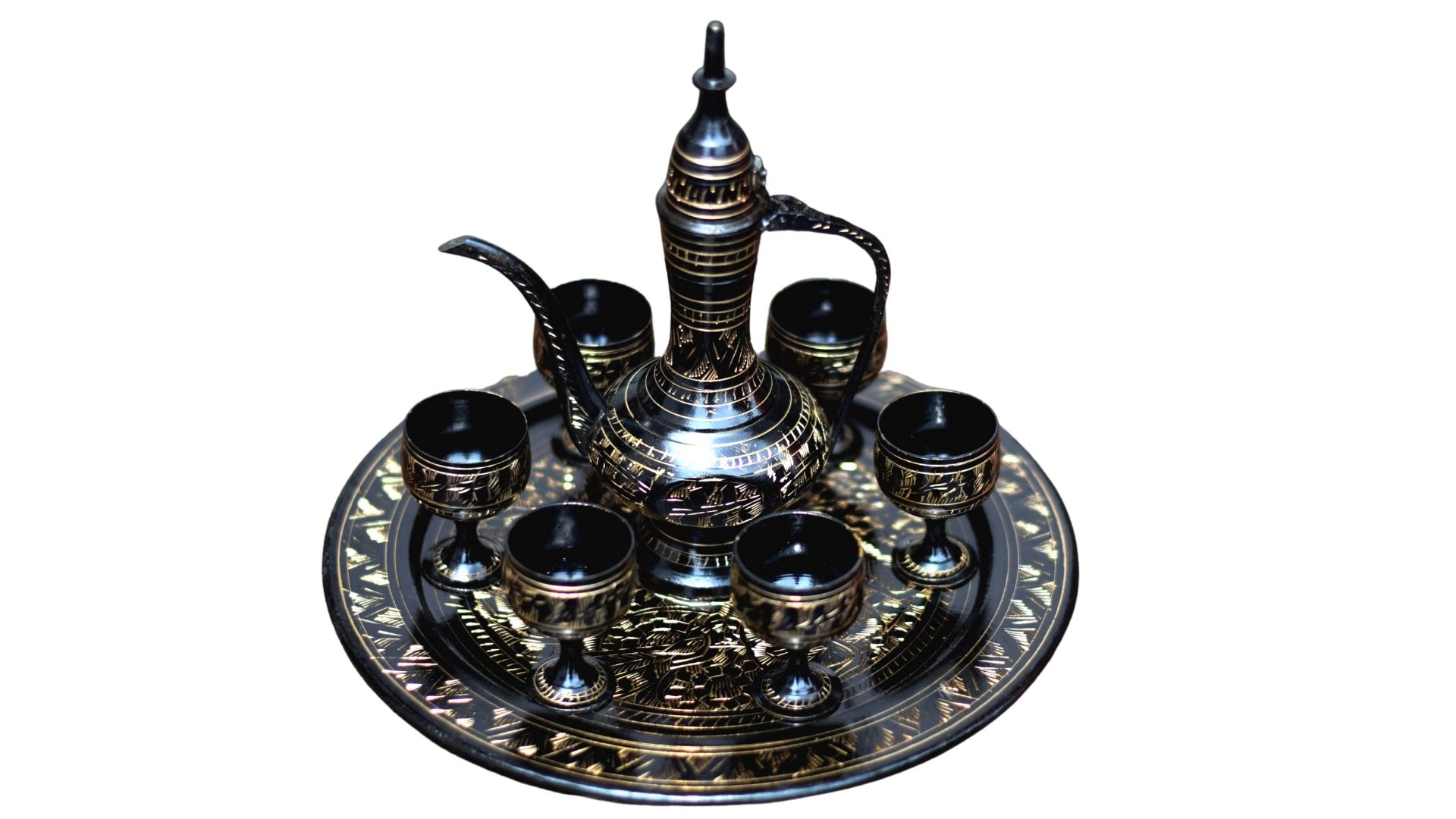


Brass Royal Wine Glass And Surai Set Decorative Showpiece
₹1,199.00
Material:Brass
Item Include:6 Wine Glasses, 1 Surai and 1 Plate
Color: Black & Golden
Weight:900gms
Diameter of Plate:24cms
Height of Surai:20cms
Wine Glass Height:5cms
Country of origin: India
*Decorative Brass Wine cups and surai set can be used as decorative pieces and also for interior of your beautiful homes
*It is also a perfect gift for people who love to collect small and antique articles
*Its versatile design, intricate artistry and superlative craftsmanship makes this ideal for your home and office desks
*This brass showpiece is diligently handcrafted by skilled artisans using various traditional techniques
Create महफ़िल–ए–समा feeling at your home with this beautiful looking Traditional Surahi Set
Decorative Brass Wine cups and surai set can be used as decorative pieces and also for interior of your beautiful homes. It is also a perfect gift for people who love to collect small and antique articles. Its versatile design, intricate artistry and superlative craftsmanship makes this ideal for your home and office desks. This brass showpiece is diligently handcrafted by skilled artisans using various traditional techniques.
This beautifully handcrafted Surahi is made by the master artisans of India. Decorate like never before. A perfect blend of old and modern era. The real beauty of this Surahi is in detailed design and hand-work, carved by expert artisans giving it an ethnic and unique look.
A perfect mixture of zinc and copper, brass is known to be one of the most versatile alloys known to us. Arguably marking its first appearance somewhere around 500 BC, the popularity of brass has only increased with time.
PRODUCTION PROCESS:
Brass metal is an alloy of copper and zinc and the quality of the metal depends on the Percentage composition of both these metals. Various processes involved in the manufacturing of brassware. The task of making brassware requires a team of skilled artisans having considerable expertise in various areas. For instance, a skilled engraver is needed for the task of engraving, a skilled enameller is needed for the task of enameling, similarly, many others are required for additional responsibilities. Moreover, this Traditional craft is probably five hundred years old and these artisans learned this traditional art form from their ancestors and forefathers engaged into this practice from many generations.
STAGES FOR MAKING A BRASSWARE ARE:
Mould Making- The first step is to make the mould or ‘master-piece’ from which multiple products would be replicated (cast). These are usually made of wax, as it is soft and easy to work with. Sometimes wood is also used. This master copy is always created in two (or more) detachable halves to make sand casting convenient.
Melting- Brass is prepared by melting scrap-metal to approximately coal-fired furnaces. The raw materials are a mix of many metals namely copper, zinc, lead, etc. in a specified ratio. A flux is also added to remove the impurities. These are molten in a huge container for about twelve hours to produce 350 kilograms of brass at one go. The molten metal is left to cool on basic iron molds to form strips that are then sent to the casting craftsmen.
Casting- Sand casting is the traditional method of making brass ware. Sand is used in the two halves of the mould box to cast the metal which is prepared by packing sand (locally called ‘masala’) around the ‘master copy’ tightly. The chemical binder in the sand aids in holding the shape of the mould after which it is removed, and molten metal poured in its cavity. After being allowed to cool for a few minutes, the cast metal is removed from the mould box. The sand and the ‘gating’ (pathway made in the mold for directing the flow of molten metal into the cavity) are broken from the cast using a hammer. These are re-used in the next casting.
Scraping- The cast metal is mounted on a cylindrical wooden block, which in turn is attached to the headstock of the lathe machine. Various chisels and files are used to scrap the spinning cast and smoothen its surface of any irregularities. Sometimes when the product is made in parts, it is first welded together and then sent for scraping and polishing. Metal shavings are re- used in the next melting.
Engraving- Engraving is the most refined and artistic of all the processes. The design that must be engraved is first sketched on paper and then scaled-up according to the size of the product. Measurement is an important aspect to make the pattern look harmonious and lyrical. These are mainly inspired from different forms of nature like trees, flowers, birds, and animals. The geometric ones have their influence from the Mughal architecture. First, an outline of the whole design is done with a fine engraving tool hammered with a wooden block. After that, broader tools are used to engrave the background and give depth to the pattern. These are often filled with colorful lac or enamel.
Polishing- Polishing mainly includes cleaning the brass ware with a soft scrub and then buffing it on the machine for golden sheen. The work of washing, shaping and polishing handicraft metal items is carried out in the domestic units.
Drinking wine was an important aspect of the Mughal-Indian era that it was clearly depicted in some Indian manuscripts. For example, the era of Jahangir showed how fond he was fond of wine and opium. He was often depicted holding a cup in different scenes, whether manuscripts or coins minted at that time. In addition, different materials were used in their manufacturing to faithfully express the development of applied arts in the era of Mughal emperors in India, in general, and that of Jahangir, in particular.
The Mughal, Mogul or Moghal Empire, was an early modern empire in South asia.For some two centuries, the empire stretched from the outer fringes of the Indus basin in the west, northern Afghanistan in the northwest, and Kashmir in the north, to the highlands of present-day Assam and Bangladesh in the east, and the uplands of the Deccan plateau in south india.
The Philosophy of Mughal’s Interest in Wine Cups:
Before Jahangir
Over the different Islamic eras, the scenes of drinking wines and the various tools and applied artifacts used for this purpose were known. For example, princes were depicted in wine circles. Therefore, wine scenes were executed in Fresco on the Abbasid palaces, the Mamluk metal artifacts in Egypt and Syria (1250-1517), the manuscripts of Mughal Ilkhanate (1265-1335), the Persian painting at the time of the Timurid rulers (1387/1502) and Safavid rulers (1502/1737) depicting wine scenes in courts and picnic times that reflect the culture of the age . In the Mughal era, although drinking wine was
prohibited by Islam, this culture disseminated that it became an integral part of the Mughal court. Many poet of the Persian literature handled wine, its drinking and symbolism. Additionally, some poems of the Persian literature discussed the various kinds of wine, they were known as alkhamiria . For example, in Punjab as well as other Indian provinces, many poets discussed wine and dedicated full poems to it . At that time, the Sufi thought greatly flourished affecting drinking wine. It represented various religious rituals, not only drinking. Many historians reported the spread of Mysticism in India
that played a great role in the dissemination of such customs in the Mughal court, as reported by Jahangir in his memories. The cups used were not only to drink wine but they had a certain symbolism. While the cup represented the world, the wine was the elixir of life. At that time, Sufi poems discussed drinking wine as a form of spiritual pleasure that brought them closer to Allah. Although wine is prohibited in Islam, Allah promised believers that they will enjoy pure wine that will not make them drunk or sick and it has good flavor. To the Sufi as well as others, wine symbolizes paradise. For example, Sufi poetry reports it as kaís al-maÉabba (the loving cup) . Abd Elnabi Fakhr Alzamani was one of the most important poets; he visited India in 1017 and joined the court of Jahangir . Generally, wine spread in India in the Mughal era because it was advisable to drink wine in cold weather . Drinking wine also spread in the Mughal court before Jahangir. For example, Babur (1526-1530) was fond of wine and was described as the great drunk. He used to celebrate victory in parties where wine was drunk extensively. Furthermore, he used to before fighting wars . He also had a set of wine cups made of precious metals, including gold and silver, but they were destroyed in his lifetime . Humayun (1530-1539) and (1555-1556) was an addict of opium as mentioned in his memoir . Instead of torturing enemies, He used wine for investigations. For example, after seizing Champanir, Humanyun knew that Bahadir Shah was hiding a treasure. Thus, he ordered his soldiers to make Bahadir Shah drunk instead of torture to know the place of treasure. Abu Elfadl, the minister, reported that Akbar (1556- 1605) was an addict of opium and alcoholic . By nature, Akbar was a Sufi and loved meditation . He was known to be alcoholic from his 18 that he used to drink more than 20 cups a day. Roe reported that the smell of wine emitted from Akbar’s court . At his time, the senior statesmen drank wine, especially on certain occasions
nd hunting trips and he also drank with them . The new legislation that he issued included an article that permitted wine drinking as it supports the body according to the physicians’ recommendations. He also allowed establishing a shop, near the palace, to sell wine that he regulated work there and fixed wine prices.
Jahangir (1014-1037 H./1605-1628) and his interest in drinking wine:
Jahangir succeeded his father . He was the first Mughal ruler to has the title of (Djahngir) or (World-seizer); the king of the world. Therefore, he is depicted standing on the earth and the sun behind the throne . He was fond of grandeur and splendor that his procession was incredibly magnificent with 10,0000 horsemen, more than 250,000 animals, about 500,000 persons, and a large number of elephants and predators. It extended to 1.5 miles . Although Islam prohibited drinking wine, Jahangir drank a lot of it . He also liked Sufism, mysticism and Alborhamia doctrine . He was alcoholic from the age of 18 . At the age of 46, he became an opium addict. However, he deeply regretted the time spent in drinking alcohol or opium addiction . On drinking wine, he was sobered down although, he was sobered up in other times . Later, his hands trembled that he was not able to drink wine, but with the help of another person . He had a famous motto that “I wanted only a bottle of wine and a piece of meat to keep myself merry” . His great love for wine might be attributed to the fact that he was brought up and educated by Shiekh Saleem in Sakarya near Agra and Jahangir was named after him. Jahangir was brought up in an environment of Sufism. Sufis used to drink wine as they believed that it was a great motif to faith and it has a special symbolism .
| Weight | 1000 g |
|---|
1 review for Brass Royal Wine Glass And Surai Set Decorative Showpiece
Add a review
Vendor Information
- Address:
- 4.61 rating from 327 reviews


Gift Hamper


Kitchen & Dinning


Related products



Gift Hamper


Gift Hamper
Gift Hamper


Gift Hamper


Gift Hamper


Gift Hamper


COD Not Available


Gift Hamper


Gift Hamper


Mustaq Ahmed –
My Abbu love it.