


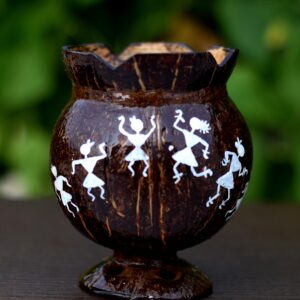
Eco-Friendly Nature Handicrafted Coconut Shell Vase
₹1,199.00
Material : Coconut shell
Product Weight: 240 gm
Product Height: 14 cm
Diameter : 11 cm
Color : Brown
Package: Set of 2 Vase with Woolen Flower
Purpose: Decoration
Country of origin :India
*Eco friendly and Food Safe
*Natural Finish – polished with pure coconut oil
*100% Nature and free from Chemical activities
*Attractive Flower vase made with coconut shells
*Bring beauty to your home, office and any other place
*It is deal to give as a thoughtful and unique gift to a loved one.
आओ घर को सजाएं
Beautiful hand carved art sculpture flower vase made from single coconut husk. Instead of using plastic vase we can use natural flower vase for dry flowers.
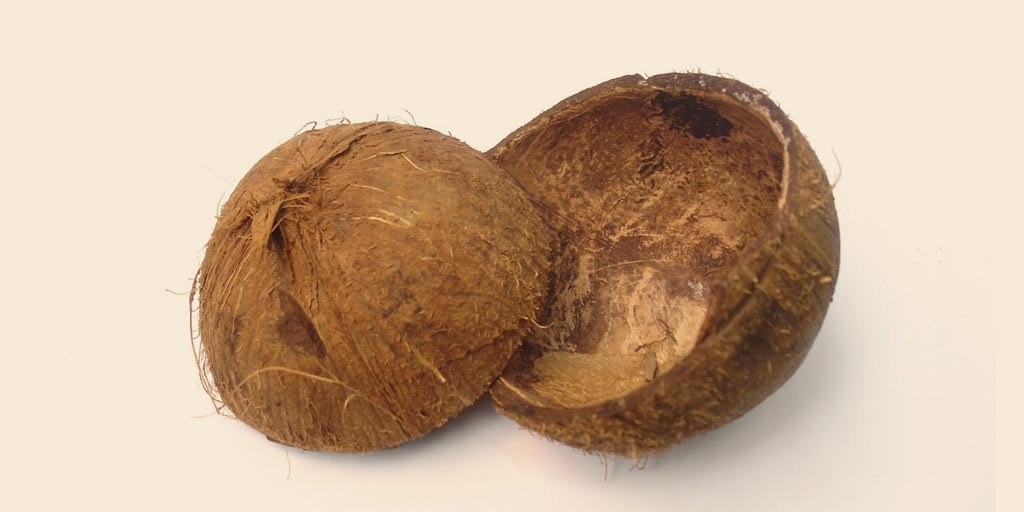
The term coconut refers to the fruit of the coconut palm, which consists of a fibrous husk (mesocarp) encasing a large seed or inner stone. The term coconut also is used to refer to the entire large seed with its covering of hard, green, fibrous endocarp, or to the edible, commercially important, white and fleshy part of the seed (the coconut “meat” or endosperm), which in turn surrounds the hollow, fluid-filled, central cavity. The hollow center is generously filled with a clouded yet translucent, flavored liquid (liquid endosperm) slightly thicker in consistency than water.
While the origins of the coconut are subject to controversy, including areas of south Asia, northwestern South America, New Zealand and India, it has spread generously across the tropics, thriving on sandy soils.
The coconut palm today is grown throughout the tropical world, for decoration as well as for its many culinary and non-culinary uses. Virtually every part of the coconut palm has some human use. For example, the white, fleshy part of the seed provides food; the coconut water provides a nutritious drink; the fiber left over from coconut milk production is used as livestock feed; the apical buds are edible (“heart-of-palm”); and the nectar is used to make a drink. Furthermore, the fiber from the husks is used to make ropes, brushes, and other items; the leaves are used for baskets and roofing thatch; the palmwood is used for furniture and construction; the trunk is used to make drums, containers and small canoes; and the roots provide a dye and medicine; among many other uses.Coconuts are extensively used in Hindu religious rites. Coconuts are usually offered to the gods, and a coconut is smashed on the ground or on some object as part of an initiation or inauguration of building projects, facility, ship, and so forth. This act signifies a sacrifice of ego, the idea that wealth stems from divinity, and the idea that, if due credit is not given, bad karma is taken on. In Hindu mythology it is referred as Kalpavruksha. In Hindu mythologies, it is said that Kalapavruksha gives what is asked for.
*The indonesian tale of Hainuwele tells a story of the introduction of coconuts to Seram.
*The people of the state of Kerala in southern India consider Kerala to be the “Land of Coconuts”; nalikerathinte naadu in the native language.
*”Coconut” is New Zealand slang for a Tongan, or other person of “Polynesian” descent, although usually not Maori.
*Kurumba is used as a term for coconut (Maldives).
The Sanskrit name for coconut is kalpa vriksha, which means “the tree that provides all the necessities of life.”
Coconut shell oil can be used as a medicine for various skin diseases. Activated carbon, manufactured by heating coconut shells at very high temperatures in kilns, is used for purification of fruit juices, vegetable oils, glycerine and jaggery. It is also used for water purification.
| Weight | 550 g |
|---|
Be the first to review “Eco-Friendly Nature Handicrafted Coconut Shell Vase”
Vendor Information
- Address:
- 4.61 rating from 327 reviews





Related products


Gift Hamper



Gift Hamper


Gift Hamper

Gift Hamper


Gift Hamper


COD Not Available

Ceramic


Gift Hamper

Gift Hamper
Reviews
There are no reviews yet.